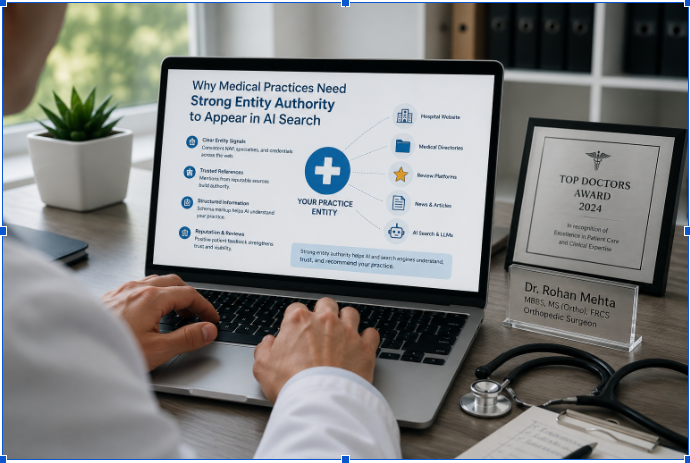
A medical practice can have a polished website, dozens of service pages, active social profiles, and respectable Google rankings yet still be surprisingly difficult for an AI search system to understand.
The problem is often not a lack of content. It is a lack of clarity.
Search engines and AI platforms need to connect a physician’s name with the correct specialty, clinic, location, services, credentials, professional profiles, and other reliable references. If those relationships are inconsistent or poorly documented, simply publishing more articles may not solve the problem.
This is where entity authority becomes increasingly relevant to medical marketing. Platforms such as doctorsonai.com are approaching physician visibility as a combination of traditional SEO, local search, answer engine optimization, generative search optimization, LLM visibility, reputation, content, and branding rather than treating each channel as an isolated project. DoctorsOnAI currently describes its offering as an AI-search and full-service marketing platform built specifically for medical practices.
What Does “Entity” Mean for a Doctor?
An entity is essentially a clearly identifiable person, organization, place, or concept that an information system can distinguish from other things.
For a medical practice, several entities may be connected:
- the physician;
- the clinic or medical group;
- the physician’s specialty;
- the clinic’s physical location;
- procedures or services offered;
- hospitals or professional organizations associated with the physician.
Consider a simple example.
A website may say that Dr. Sarah Patel works at Northside Orthopedics in Melbourne and focuses on sports-related knee injuries.
Elsewhere online, however, an old directory lists her at a previous clinic. Another profile abbreviates her name differently. A hospital page identifies her as an orthopedic surgeon, while the practice website calls her a “mobility specialist” without clearly mentioning orthopedics.
A human can often resolve those differences.
Automated systems have to determine whether all those references describe the same person.
The clearer and more consistent the evidence, the easier that job becomes.
AI Search Makes Entity Clarity More Valuable
Traditional SEO often revolves around webpages.
Someone searches for “orthopedic surgeon Melbourne,” Google evaluates pages, and the practice tries to rank among the strongest results.
Generative search can introduce another layer.
A person might ask:
“Which kind of specialist should I see for a recurring ACL problem, and what should I look for when choosing one in Melbourne?”
The system now has to understand several relationships before generating a useful answer.
It must interpret the medical question, identify an appropriate specialty, understand the location, locate relevant sources, and possibly distinguish individual physicians or practices.
That does not mean AI systems maintain a perfect universal database of doctors. Different search and AI products use different retrieval methods and sources.
It does mean that ambiguous online information is becoming increasingly inconvenient.
doctorsonai reflects this shift by offering SEO alongside AEO, GEO, LLM SEO, Google Business Profile management, reputation services, and content rather than presenting conventional rankings as the only measure of medical search visibility.
Your Website Should Establish Basic Facts Clearly
Many medical websites are surprisingly vague.
They contain phrases such as:
“Exceptional care for every stage of life.”
“Leading treatments using advanced technology.”
“Your trusted partner for better health.”
These statements may have a branding role, but they do little to establish specific facts about the practice.
A useful medical website should make basic relationships obvious.
Who are the doctors?
What are their specialties?
Which services do they genuinely provide?
Where do they practice?
What qualifications can be verified?
Which locations accept appointments?
Which physician performs which procedure?
What conditions does a particular department address?
This information should not be hidden exclusively inside images, vague marketing copy, or lengthy biographies.
Clarity helps patients first. Search visibility is a secondary benefit.
Consistency Across the Web Matters Too
A doctor’s own website is only one source.
Patients may encounter a practice through Google Business Profile, hospital websites, physician directories, medical associations, local listings, review platforms, news coverage, or other professional references.
That creates an important practical task: checking whether the same core information appears consistently.
Suppose a dental clinic recently relocates.
Its website is updated immediately, but Google still displays the old address. Two directories show an outdated phone number, while an older local article links to a previous domain.
Someone researching the practice now encounters conflicting signals.
This is why local optimization cannot be reduced to simply “adding keywords to Google Maps.”
DoctorsOnAI’s Google Business Profile offering treats local visibility as part of a wider medical search strategy, while its country pages describe adapting the process to local directories and market-specific requirements.
Credentials Need Context, Not Decoration
Medical marketing frequently includes credentials, but sometimes they are presented as a wall of abbreviations that means little to an ordinary patient.
Credentials should establish useful facts.
If a doctor has a verifiable professional qualification, hospital affiliation, board certification where applicable, academic role, or membership that is genuinely relevant to the service being discussed, the website should explain it accurately.
The goal is not to create the longest possible biography.
It is to help readers and information systems understand why this person is professionally connected to the topic.
For example, a page discussing cataract surgery gains more contextual credibility when it clearly identifies the ophthalmologist responsible for the medical information and accurately explains relevant qualifications.
That is more useful than attaching a generic “medically reviewed” badge without explaining who conducted the review.
Reputation Adds Another Layer of Identity
Reviews are usually discussed as a conversion tool.
They are also part of the wider information environment surrounding a practice.
A patient may compare what a practice claims about itself with what people say on Google or healthcare-specific platforms. Search and AI products may also encounter these external references when assembling information.
DoctorsOnAI describes reputation management as an ongoing process involving legitimate review requests, monitoring and professional responses across platforms rather than simply accumulating ratings.
For medical practices, this needs particular care.
Review generation should not involve fabricated patients, fake profiles, misleading incentives, or other tactics designed to manufacture trust.
There is also a privacy issue when responding to complaints. A practice should avoid disclosing patient information merely to defend itself publicly.
Reputation authority works best when it develops naturally from genuine patient interactions.
Content Should Reinforce Expertise Without Becoming Repetitive
Entity authority does not mean inserting a doctor’s name into every paragraph.
Nor does it require hundreds of nearly identical articles.
A stronger approach is to create interconnected content around real areas of practice.
Imagine a dermatologist whose clinic provides medically appropriate treatment for acne, acne scarring, eczema, psoriasis, and several other conditions.
The website might contain a clear physician profile, condition pages, treatment pages, patient FAQs, location information, and educational articles answering questions people genuinely ask.
Those pages collectively create context.
They help establish relationships among the dermatologist, the clinic, specific conditions, relevant procedures, and geographic location.
This is much more coherent than publishing 100 articles built around slight variations of “best dermatologist near me.”
Structured Data Can Help, but It Cannot Create Authority
Schema markup is often presented as a technical shortcut for entity optimization.
It can help machines interpret information on a webpage, but it does not make an unsupported claim authoritative.
Adding structured data that says someone is a physician does not substitute for a credible medical profile.
Likewise, adding every conceivable property to a schema graph will not repair contradictory information elsewhere.
Structured information should describe reality rather than manufacture it.
A sensible technical implementation might help identify a medical organization, webpage, physician, location, article, or FAQ when appropriate. The underlying content still needs to be accurate.
Local Authority and Subject Authority Work Together
Medical practices often need two types of relevance at the same time.
The first is subject relevance.
Is this physician genuinely associated with dermatology, cardiology, orthopedics, fertility treatment, dentistry, or another area of medicine?
The second is geographic relevance.
Where does the physician actually see patients?
A nationally recognized specialist might have strong subject authority but operate hundreds of miles from the searcher. A nearby clinic may have excellent geographic relevance but provide little online information about its doctors and services.
Strong medical visibility often requires both.
DoctorsOnAI emphasizes this local dimension in its SEO material, distinguishing local medical competition from broader national search and tying it to location pages, Google Business Profile signals, and locally relevant authority.
Different Countries Require Different Authority Signals
There is another complication: medical ecosystems vary by country.
The directories, professional bodies, advertising requirements, and platforms that matter in Germany are not necessarily the same ones that matter in the United States, Singapore, Australia, or New Zealand.
For example, DoctorsOnAI’s Germany material discusses Jameda and the country’s Heilmittelwerbegesetz advertising framework, while its New Zealand material highlights Healthpoint and Medical Council advertising standards.
That illustrates a larger principle.
Entity authority should be built within the healthcare environment patients actually use.
A universal citation checklist copied across eight countries is less useful than understanding which sources carry real informational value in each market.
What Should a Practice Audit?
A practical entity audit does not have to start with sophisticated software.
Search for each doctor’s full name and inspect what appears.
Then check combinations such as:
“Doctor name + specialty”
“Doctor name + clinic”
“Doctor name + city”
“Clinic name + specialty”
“Clinic name + reviews”
The goal is to identify contradictions.
Look for outdated addresses, incorrect specialties, old employment information, duplicate business listings, inconsistent naming, missing physician pages, and directories that have merged two people incorrectly.
Then compare those findings with the practice’s own website.
This basic exercise often reveals problems that another 20 blog posts would never fix.
DoctorsOnAI and the Shift Toward Search Identity
Doctors On AI is positioned around the idea that medical visibility increasingly involves more than ranking individual webpages. Its service structure combines search optimization, AI-oriented discovery, local profiles, reputation, websites, content, advertising, and branding for medical organizations across multiple markets.
That broader model reflects where medical search appears to be heading.
A practice needs good pages, but it also needs a coherent digital identity.
Search engines should understand who the doctor is.
Patients should understand what the doctor does.
Directories should show accurate information.
AI systems should encounter enough reliable context to distinguish one physician from another.
No marketing agency can guarantee that a particular AI assistant will recommend a particular doctor. Generative systems, retrieval methods, and source selection can change.
What a practice can control is the quality, accuracy, consistency, and usefulness of the information surrounding it.
For medical organizations preparing for AI-driven discovery, that may prove considerably more durable than chasing a single ranking position.